
The 2026 Owner-Operator Playbook: Maximizing Every Mile in the Northeast
For owner-operators, the game has changed. The days of taking any load just to keep the wheels turning are over. As we hit the midpoint of 2026, the Massachusetts and Northeast freight markets are finally leaning back in favor of the driver—if you know where to look.
The New Profit Reality
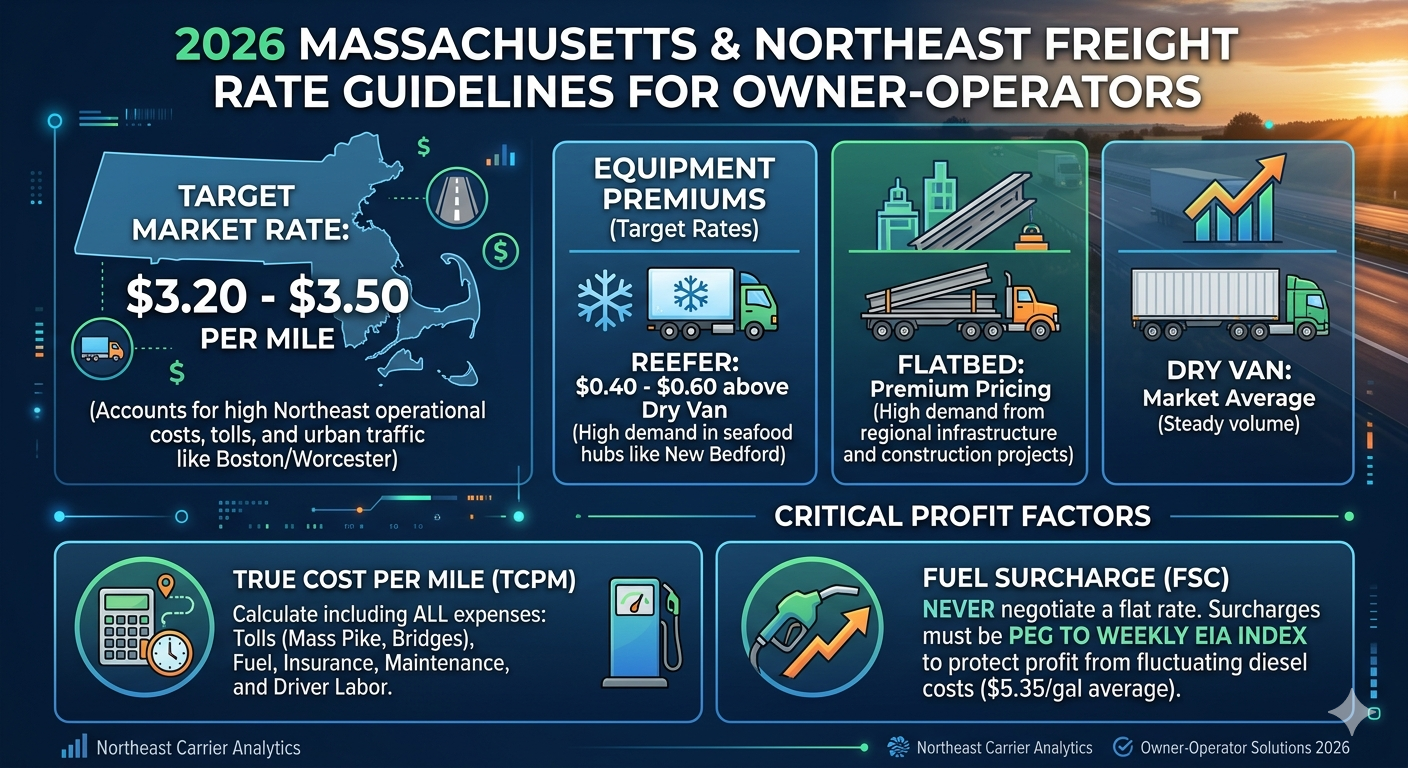
While national spot rates have stabilized around $2.79 per mile, the Northeast corridor is a different beast. With high tolls on the Mass Pike and I-95, plus dense urban traffic in Boston and Worcester, your “all-in” rate needs to be higher to maintain a healthy margin.
Currently, top-tier owner-operators in the MA region are targeting $3.20 – $3.50 per mile for short-haul regional work to offset the high cost of operations in New England.
3 Strategies to Boost Your Bottom Line Right Now
1. Master the “Backhaul” Math
Massachusetts is a massive consumption state. Plenty of freight comes in, but finding high-paying freight out can be a challenge.
- The Move: Don’t get stranded in Boston. Look for loads heading toward Springfield, MA or Albany, NY. These hubs are “reloading zones” where you can snag higher-paying outbound freight toward the Midwest or South.
2. Specialized Equipment = Premium Pay
Standard dry van rates are decent, but the real money in 2026 is in Reefer and Flatbed.
- Reefer: With New Bedford being a global seafood hub, cold-chain capacity is always in demand. Reefer rates in MA are currently averaging $0.40–$0.60 higher per mile than dry van.
- Flatbed: Infrastructure projects along the I-495 beltway have created a surge in demand for construction materials. If you can haul it, you can name your price.
3. Watch the Fuel Surcharge
With diesel hovering near $5.35/gallon, a flat rate is your enemy.
- The Move: Never negotiate on the “total” price alone. Always break out the Fuel Surcharge (FSC). In a volatile market, ensure your FSC is pegged to the weekly EIA index so your profit isn’t eaten up at the pump before you even finish the trip.
The “Deadhead” Trap
In Massachusetts, 50 miles of deadhead isn’t just 50 miles—it’s two hours of traffic on I-93. When booking loads, use a True Cost Calculator that accounts for:
- Tolls: (I-90 and the Tobin Bridge add up fast).
- Time: If a load takes you into downtown Boston during rush hour, your “per mile” rate should double to account for the lost hours.
The Bottom Line
2026 is the year of the selective carrier. You have the capacity that shippers are desperate for. Don’t be afraid to walk away from “cheap freight” to wait for the load that actually respects your equipment and your time.